
Intermediate Hell
Why most club players plateau at 1600-1800

From my extensive research (that lasted about a grand total of about 5 minutes), the median FIDE rating across the world would seem to fall somewhere between the range of 1600-1800.
And from my own observations over the years, I would say that sounds about right.
For those with no FIDE rating, that would be roughly equal to 1800-2200 in the chess.com rapid pool.
It’s not particularly uncommon for even many ‘adult improvers’ to have a fairly smooth ride up until about that range, and then hit what feels like an absolute brick wall.
The big question though, is why do so many players end up getting stuck in this range?
‘One-Dimensional’ Thinking
From my own experience - now having worked with many players who are in the above mentioned rating range, one of the most common issues I have witnessed is what I’d like to call ‘one-dimensional’ thinking (which I’ll refer to from now on as ‘ODT’).
The problem for most club players who have hit this range is that they have often developed a set of beliefs about the game that got them to their current level - but at the same time prevents them from reaching the next one.
As chess players, we naturally tend to develop our own thinking habits over time, whether it is conscious or not.
While these can often be incredibly useful, they can also slowly turn into the very things that limit our worldview - the comfort zone that we eventually become prisoners of.
To illustrate this concept, let’s take the following plane (inspired by Dvoretsky) below, which helps us map out the various chess personalities that exist.
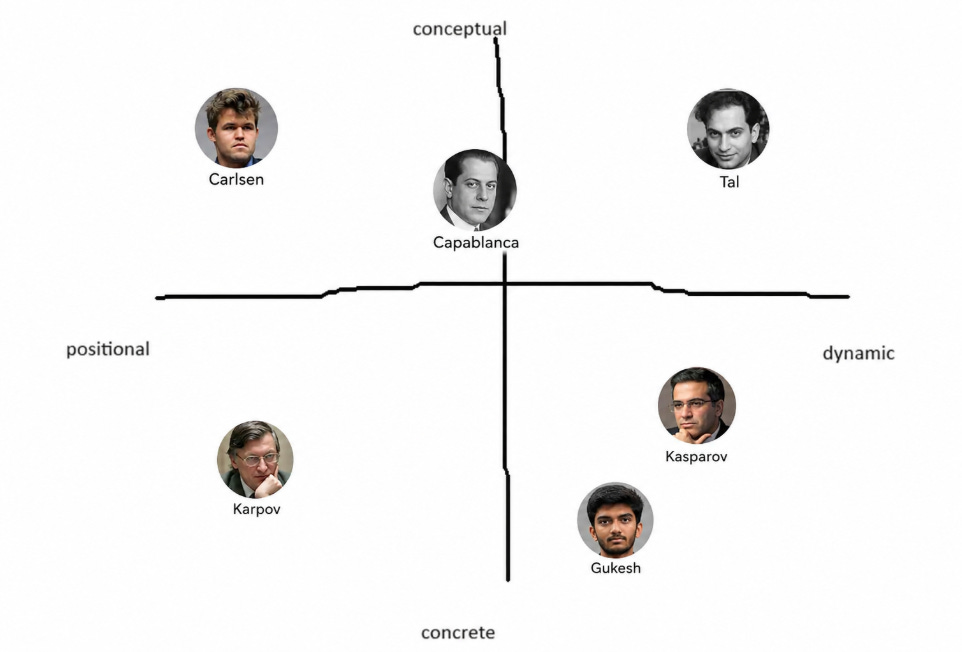
Essentially, once you’ve built some sort of foundation as a chess player - you will naturally gravitate towards some combination of being positional/dynamic, and then conceptual/concrete in the way you play chess.
Wherever you are on the map, you will inevitably have your own unique strengths, and of course also shortcomings.
Generally the stronger a player becomes, the less lopsided they will be. But even then, it isn’t truly possible for a player to be 100% ‘universal’ - every player will have their own preferences/tendencies at the end of the day.
The key distinction though, is that a master-level player with a certain ‘personality’ can tap into the other elements of the game when the position demands it. Whereas a 1600 with the same style (at least on paper) plays that way largely because it’s all they know.
To give an example of what I’d consider ODT, I want to show two key moments from a classical game of one of my students - we’ll call him JZ.
He is rated about 1750 FIDE, and falls more under the dynamic/conceptual category of players.
Generally players with this predisposition tend to have a strong preference for attacking chess, sacrifices, and the initiative. Their weaknesses often include getting a bit sloppy with their calculation (i.e. think unsound sacrifices), and not having the best grasp for more of the strategic side of the game.
One of the common tendencies we’ve noticed in his play is that he tends to misevaluate the strength of one side’s activity in many cases - whether for himself or his opponent.
While it might sound like a relatively isolated issue, you will see how this bleeds into much of his decision-making across the board.
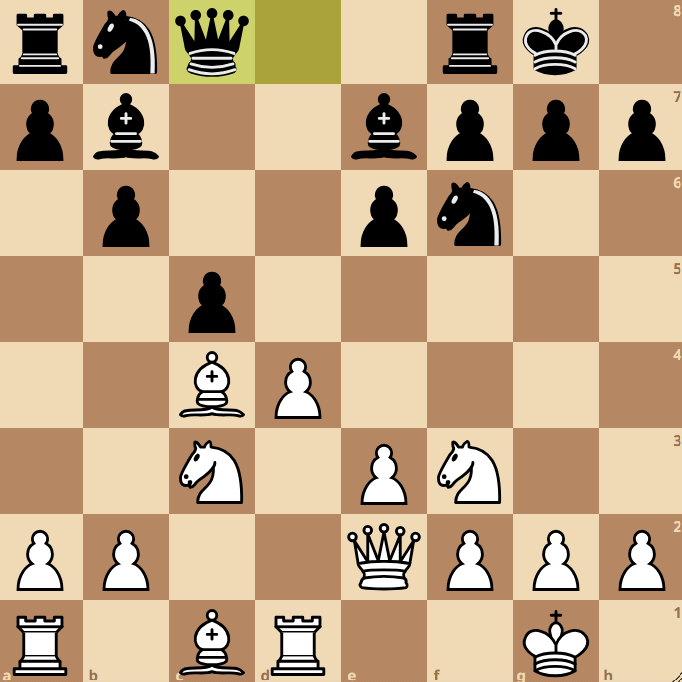
This is a relatively standard-looking position that he got from a Queen’s Gambit in the final round game of his last OTB tournament, where here he decided to play 11.d5?!.
This intuitively felt a bit wrong to me, so I was naturally curious why he played it. JZ mentioned something that I would’ve never seriously registered - he was concerned about the activity of Black’s bishop on b7.
d4-d5 was a way to shut this bishop off, and likely even exchange it as well.
There are a few issues with this thinking - but the first is that after a bunch of exchanges on d5, and Black playing …Nc6, it’s even Black who is to stand a bit better.
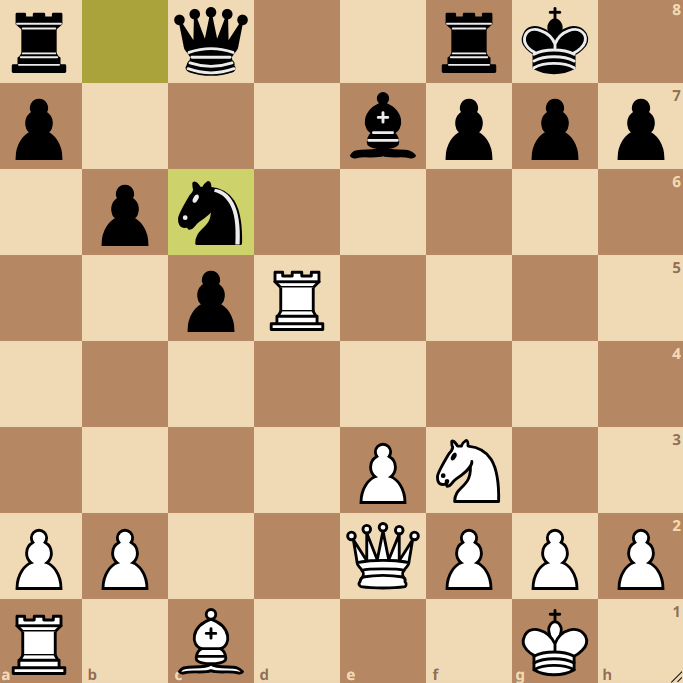
White has not really accomplished much from these exchanges, while Black now has a queenside pawn majority which is nice in the long-term (especially as the endgame gets closer), and also simple play on the next few moves like …Qe6, …Bf6, …Ra/fd8.
The other main issue, was that Black’s LSB itself was not anything White needed to take such drastic action to deal with. I mean sure, it’s a decent piece, but concretely what is it going to do to us?
In other words, much of the motivation for playing d4-d5 was coming from a place of fear - fear that the b7 bishop would somehow pose dangers to White.
White could continue in a few other ways, but I most liked 11.dxc5 followed by b3, Bb2 and Rac1 - when White should have an edge with their slightly more active pieces.
Later on we reached this position where White had fumbled around a bit, but was still roughly fine:
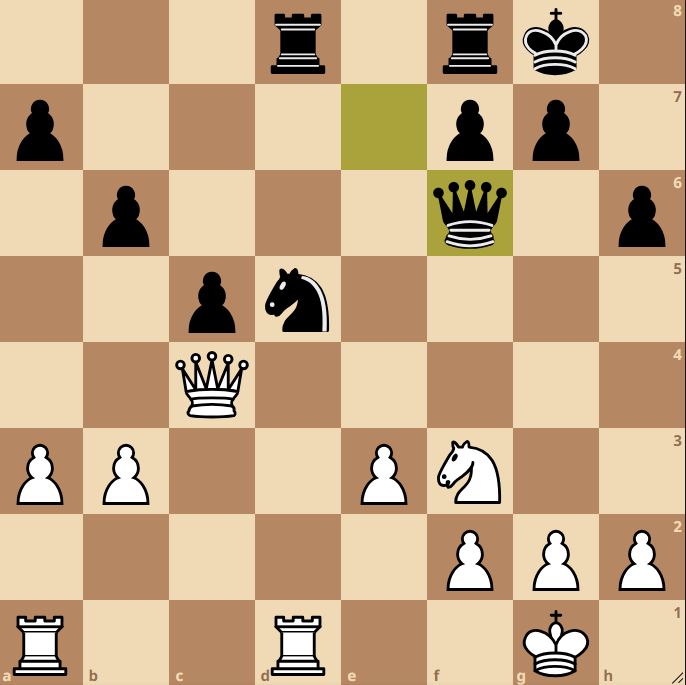
However, on the next move the very committal 24.e4? was played, and in just a few moves later White was close to lost.
Black responded …Nf4, and it became very difficult to expel that knight. The issues of the knight sitting on f4 became clear after 25.e5 Qf5 and eventually …Qg4 posed some real issues to White’s king.
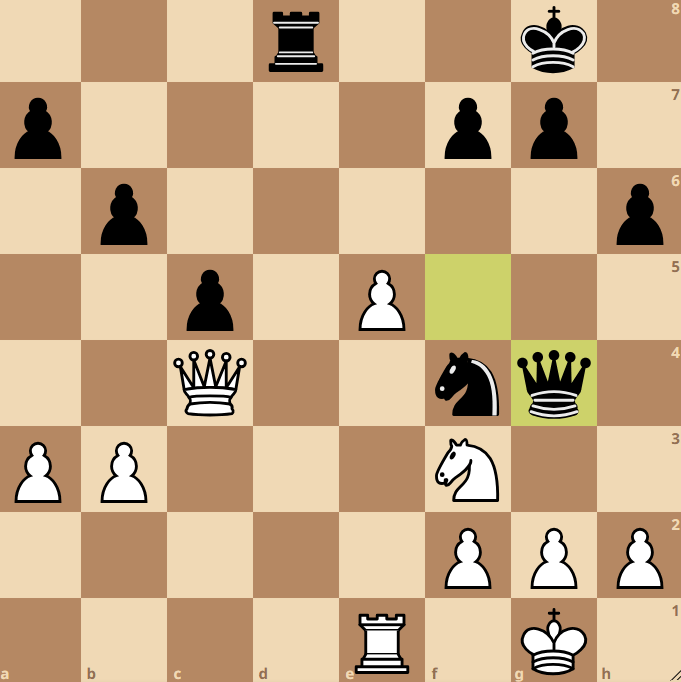
So naturally I was curious - what was it that drove JZ to play this move 24.e4?.
And again, his answer surprised me.
He was worried about Black sliding their knight into the c3 square. Again, a move which looks active - but just how worried do we really need to be?
JZ cited the line 24.Rac1, then …Nc3 25.Rxd8+ Rxd8 and White cannot take on c3 twice because of back-rank issues.
Whereas 24.e4? Nc3?? 25.Rxd8+ Rxd8 26.e5 and now all of a sudden Black’s knight is dead.
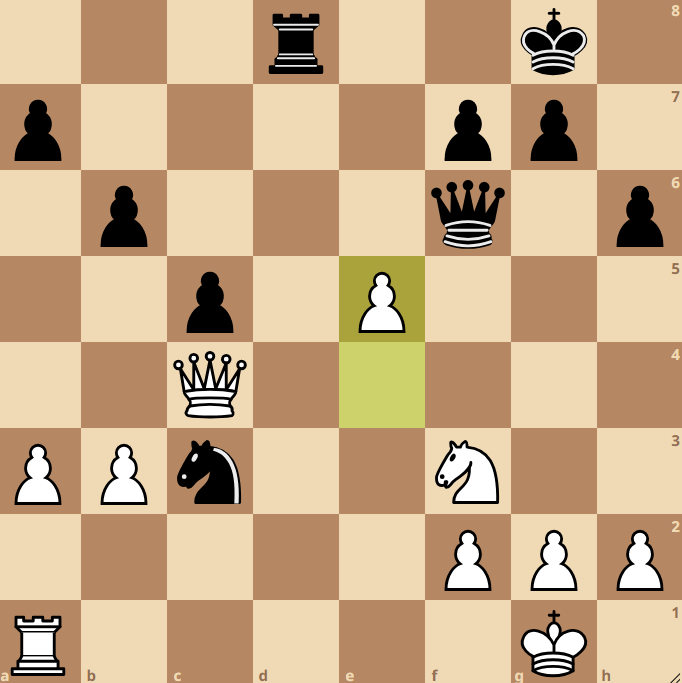
However, White is by no means forced to go into line mentioned earlier after 24.Rac1 and get back-ranked.
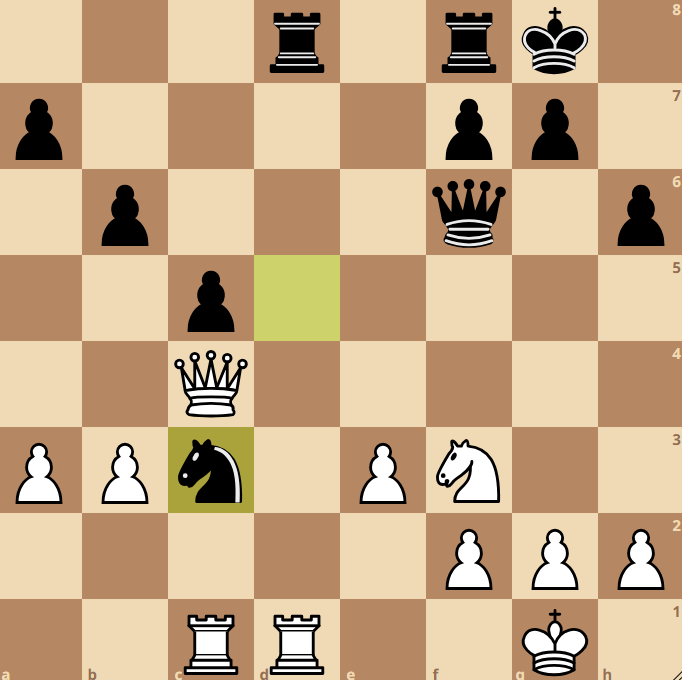
Even just 25.Rde1 after …Nc3 would pretty much force Black’s knight back to d5, when White can at the very least repeat the position with 26.Red1.
While there were some erroneous assumptions in the calculations that were made - the driving factor of this decision to play 24.e4? was again the incorrect belief that the active-looking …Nc3 move would be more unpleasant to deal with than it really was.
When in reality, the knight was rather unstable there, and did not require such drastic action on White’s behalf to prevent it from going there. Ironically, the knight landing on f4 ended up being much more difficult to deal with than a knight on c3 ever would’ve been.
So, what are your prejudices?
Apart from the few IMs and GMs who are reading this - the chances are overwhelming that you too have your own version of this.
A prejudice so deeply embedded into the way you see the board, that it doesn’t feel like a blind spot at all. It’s just your reality of the chess board.
The insidious thing about ODT is that it’s largely invisible to the perpetrator.
In both of the moments highlighted earlier, JZ was overly sensitive to a certain element of the position - and ended up creating bigger issues than the ones he was trying to solve for.
For many club players, such biases can fly under the radar for years. Subtly pulling the strings behind every decision you do (and don’t) make at the board - whether you’re aware of it or not.
The guy at your club who is petrified to give up even a single pawn, doesn’t think of himself as someone who is scared to sacrifice material. He’s just the ‘positional player’.
The gentleman who believes he is the reincarnation of Tal, and makes unsound sacrifices every other game, sees himself as the ‘attacking genius’.
Final Thoughts
While this might all seem a bit overwhelming, and also confronting to your identity as a chess player - there is a silver lining to all this.
The goal isn’t to magically turn your weaknesses into strengths.
A naturally attacking player doesn’t need to become Karpov.
A lover of positional chess and endgames doesn’t need to try emulate Tal either.
But you do need to objectively identify those prejudices you have, and be willing to step outside of what feels currently feels most natural to you.
The most difficult part about this - is that such change often often doesn’t produce the best results in the short-term, making it all the more tempting to go crawling back to your old habits.
But sometimes to take two steps forward, you must first take one step backwards.
If you want my help to identify the blind spots that are currently holding back your chess, I currently have the capacity to work with a few more students 1-1 - who have a minimum of 1600 chess.com rapid, or any rough equivalent.
You can fill out the form here to apply to work with me.
P.S. I’m running a bit of an experiment right now with a second channel on Youtube. I am currently uploading one instructive blitz/rapid game everyday there. Here is the most recent video.
Hey Sam, great post. The typifying players is also fascinating, do you remember where Dvoretsky mentioned this one? Where would you put yourself on the plane?